

Pattern & Copyright Note: Crochet patterns may vary slightly depending on your yarn, hook size, and personal tension. Use the measurements and instructions as a guide, and adjust your tension as needed. This CrochetFloria tutorial, including its instructions, photos, and original content, is protected by copyright. You’re welcome to make the finished project for personal use or as a gift. Please do not copy, republish, or redistribute the pattern or photos. To share it, please link to the original CrochetFloria article.
Affiliate Disclosure: We earn from qualifying purchases made through the affiliate links in this article, at no extra cost to you. We only recommend products that may be useful for your crochet projects.
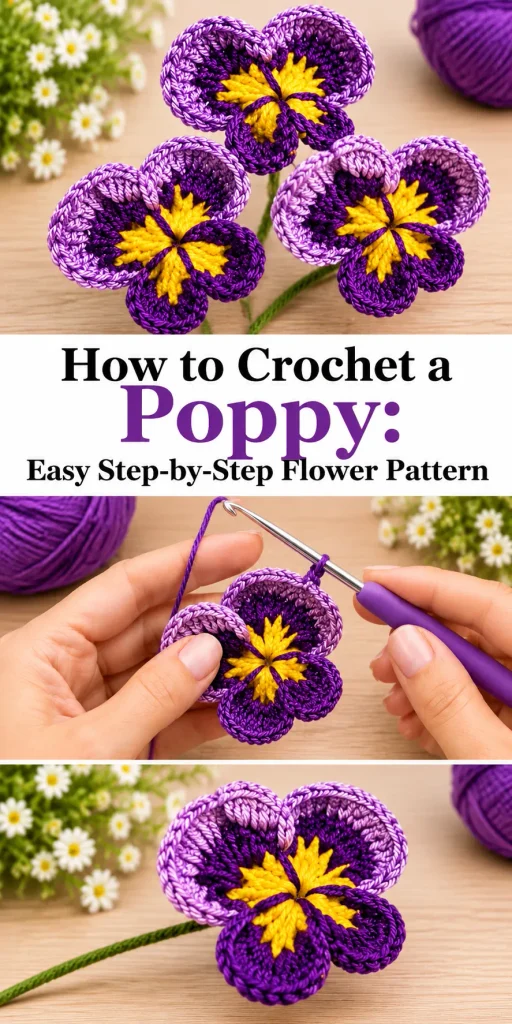
Pansies look like small faces. Each bloom has a bright yellow center, a deep violet middle layer, and soft lilac edges that ruffle slightly at the top. That color contrast is what makes a pansy so recognizable, and it is also why the flower works so well in crochet. You only need three colors, and the layers do most of the work for you.
A crochet pansy is a small, layered flower with a wire stem, worked in fine cotton so every petal stays crisp and defined. It is a different shape from the round daisies and tall tulips most crochet gardens are built around. The wide, overlapping petals give a bouquet some variety, and the finished flower is small enough to tuck into jars, bud vases, and handmade arrangements.
In this tutorial, you’ll learn how to crochet a pansy from one small flower worked in three rounds. It starts from a magic ring with four petal sections, and two more rounds build the layered look. A single piece of wire is added behind the flower to make a poseable stem, so you can use it as a bouquet flower, a small vase accent, or a decorative stem in a handmade arrangement. Because the whole flower is one piece, you can make several in a single sitting and mix the color combinations as you go.
You’ll also find a full materials list, an abbreviations guide, step-by-step instructions matched to your photos, tips for color placement, fixes for common problems, bouquet ideas, and care advice. Everything is written so you can follow along even if this is your first wired flower.
Save This on Pinterest!
Don’t have time to read this tutorial on crochet symbols and abbreviations right now? Save it on Pinterest so you can come back later and use this how to Crochet a Pansy
Why Pansies Are Worth Crocheting
Pansies are small, but they add something many crochet flowers don’t.
- The color contrast does the work. Yellow, violet, and lilac give the flower its character without needing extra embellishments.
- They’re a different look from round flowers. Many beginner flowers are simple circles, like daisies. A pansy has wide, overlapping petals that add variety to a bouquet.
- The pattern is compact. The whole flower is one piece worked in three rounds, so you can make several in a short session.
- They look best in groups. A few pansies together look like a flower bed, which makes them great for small arrangements.
- They suit many styles. Cottage-style, spring, rustic, and vintage-inspired decor all work with a pansy.
Crochet Pansy Pattern Overview
| Detail | Info |
| Project type | Crochet flower with wire stem |
| Yarn | Cotton 8 |
| Colors | Yellow, lilac, violet |
| Hook | Size B (1.90 mm) |
| Wire | 0.6 mm |
| Starting method | Magic ring |
| Parts | 1 flower (worked in 3 rounds) |
| Terminology | US crochet terms |
Materials and Tools You’ll Need
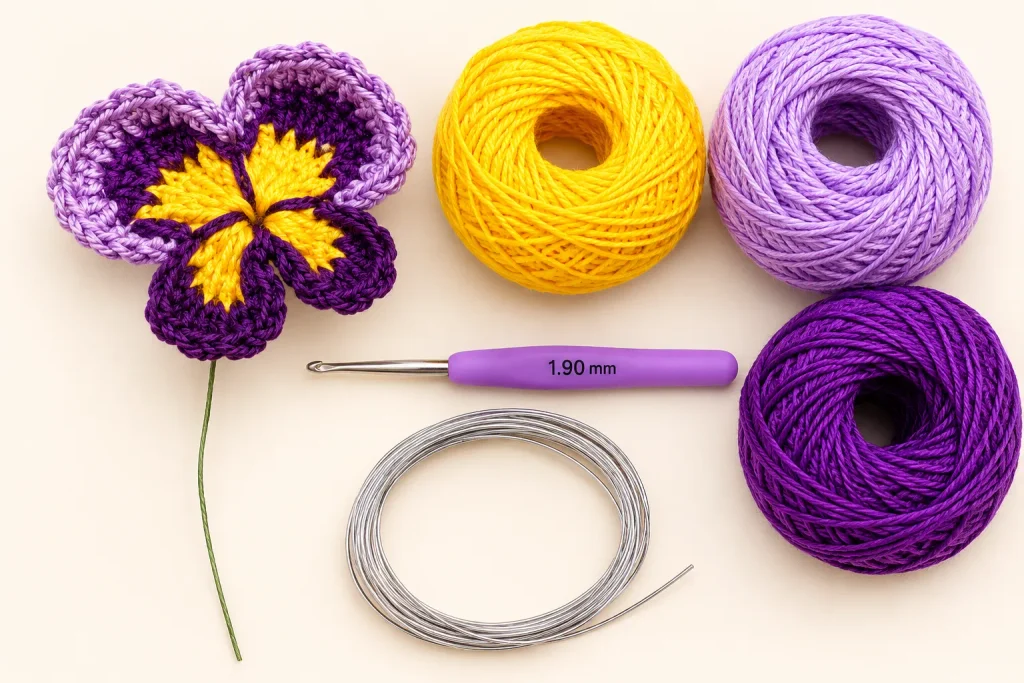
- Cotton 8 in yellow for the center of the flower.
- Cotton 8 in violet for the deeper layer.
- Cotton 8 in lilac for the outer edge.
- Crochet hook, size B (1.90 mm).
- Wire, 0.6 mm, inserted behind the flower to form the stem.
Why these materials work. Cotton has a smooth, slightly crisp finish, which keeps small petals defined. That matters on a flower this small, where each stitch is visible.
Why three colors? The color layers are what make this flower read as a pansy. Choose colors with clear contrast, so the yellow stands out against the violet and the lilac softens the outer edge.
A note on safety. Wire ends can be sharp. Fold or tuck any exposed ends, especially if you plan to give the flowers as gifts or display them around children or pets.
Crochet Supplies Quick Links
Explore useful supplies and tools for your crochet projects. These shopping links make it easier to find materials and accessories for your next handmade creation
- Cotton Yarn – Find cotton yarn in different colors for your flower.
- Cotton 8 Yarn – Browse yarn options for small crochet projects.
- Crochet Hooks – Find the right hook for your crochet work.
- Floral Wire – Useful for shaping petals and making flower stems.
- Green Florist Tape – Wrap and finish your crochet flower stems.
- Shop LoveCrafts – Discover more yarn and craft supplies.
Crochet Stitches and Abbreviations
This pattern uses US crochet terms and starts with a magic ring. If any stitch is unfamiliar, our beginner-friendly guide to crochet symbols and abbreviations explains each one in detail.
| Abbreviation | Meaning |
| ch | Chain |
| st | Stitch (used here for the joining stitch, or slip stitch) |
| sc | Single crochet |
| dc | Double crochet |
| 2 dc together | Work two double crochets together (a decrease) |
| Rnd | Round |
| … | Repeat the instructions between the asterisks |
| Magic ring | An adjustable starting ring that can be pulled closed |
Before you start: Read through the pattern once. The yarn is broken off at the end of each round, so you can switch colors as you go.
How to Crochet a Pansy Step by Step
The pansy is a single flower built in three layers. You’ll work the petals, then add two more rounds around them, then insert the wire at the back.
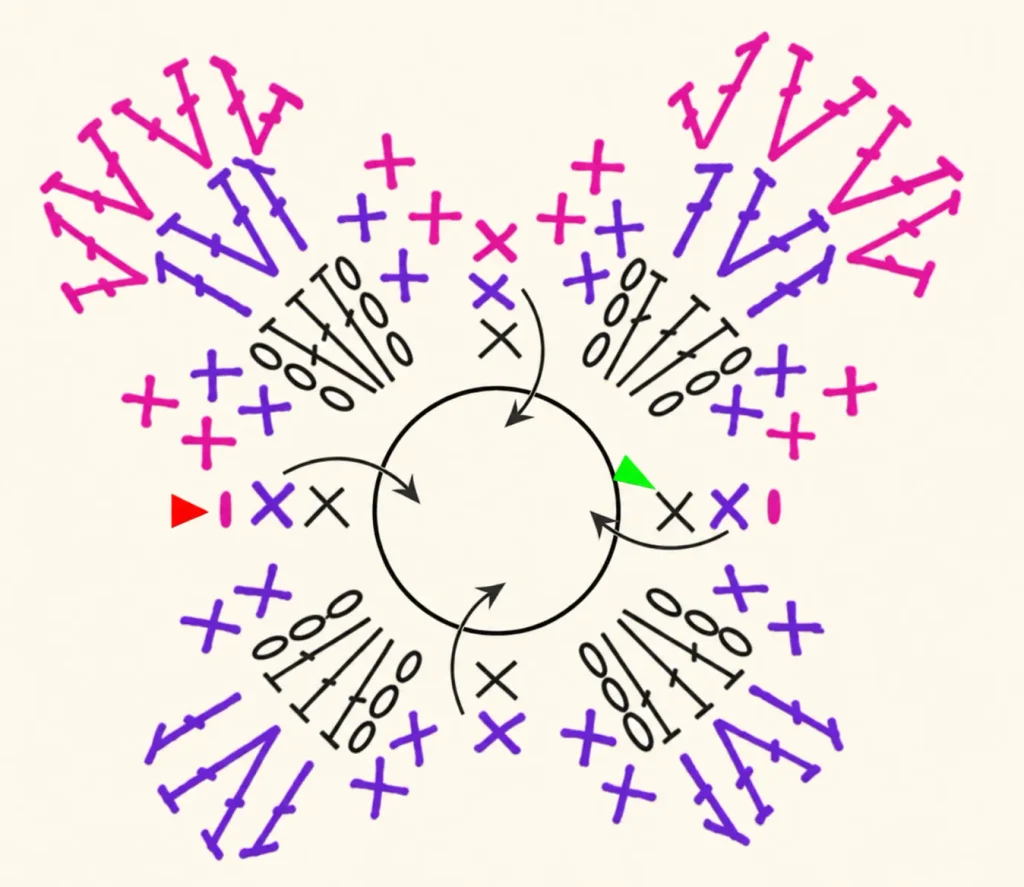
Step 1: Make the Four Petals (Rnd 1)
Begin with a magic ring.
- Rnd 1: Work into the ring: 1 sc, 3 ch, 3 dc, 3 ch. Repeat so you have 4 petals.
- Pull the loose yarn end to tighten the circle.
- Break off the yarn.
What you should see: A small four-petal flower with a closed center.
Tip: Pull the loose end firmly so there’s no gap in the middle. Weave in the tail neatly, since it will sit in the center of the flower.
Step 2: Build the Middle Layer (Rnd 2)
Attach the next color and continue around the flower.
- Rnd 2: 1 sc in the center of the flower, 2 sc into 3 chains, 1 dc, 2 dc together, 1 dc, 2 sc into 3 chains. Repeat around.
- Break off the yarn.
What you should see: A fuller flower with a second layer wrapping around the petals. This is where the pansy begins to take its layered shape.
Step 3: Add the Outer Edge (Rnd 3)
Attach the final color for the outer layer.
- Rnd 3: 1 st, 2 sc, 2 dc together, 2 dc together, 2 dc together, 2 dc together, 5 sc, 2 dc together, 2 dc together, 2 dc together, 2 dc together, 2 sc, 1 st.
- Break off the yarn.
What you should see: A flower with a wide, softly ruffled outer edge. The groups of decreases create the gentle curve at the top of the petals.
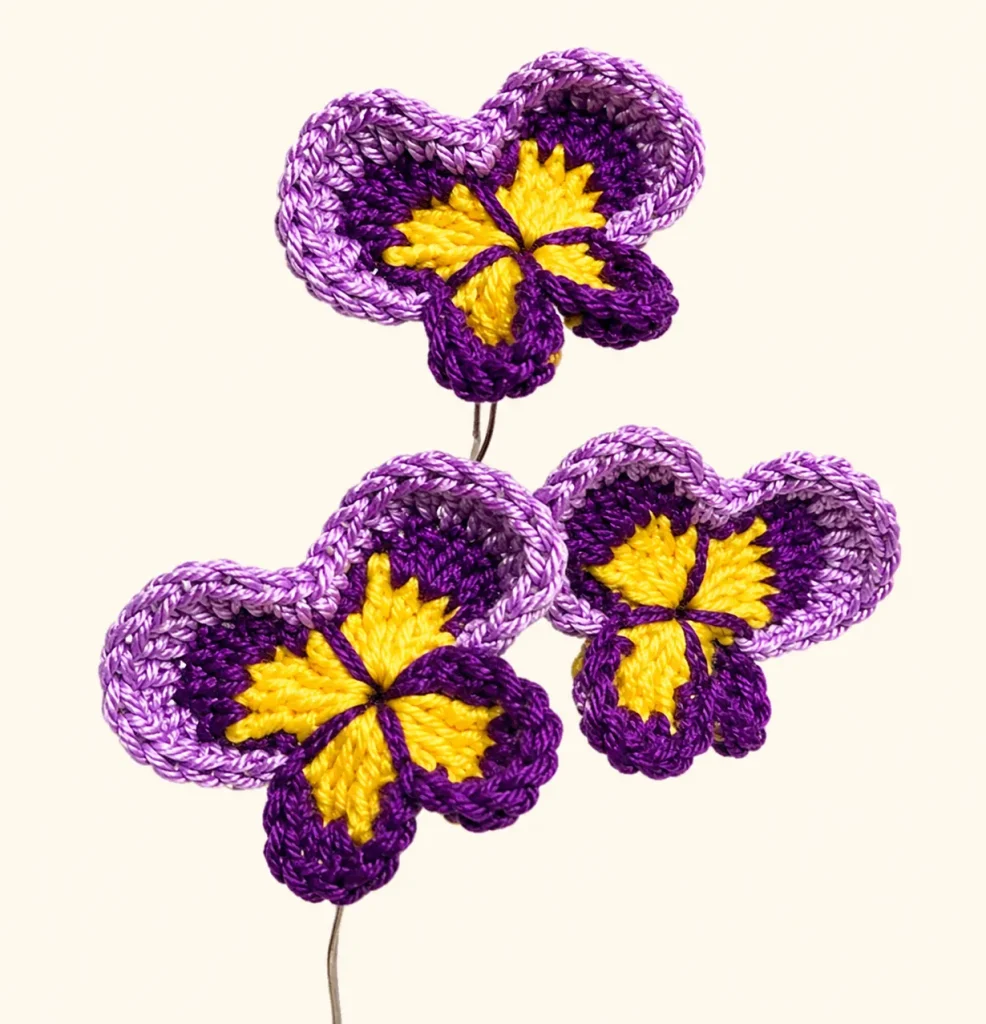
Color placement: In the photographed flowers, yellow forms the center, violet forms the deeper layer around it, and lilac forms the outer edge. Since the yarn is broken off after each round, you can assign your colors to the rounds in that order.
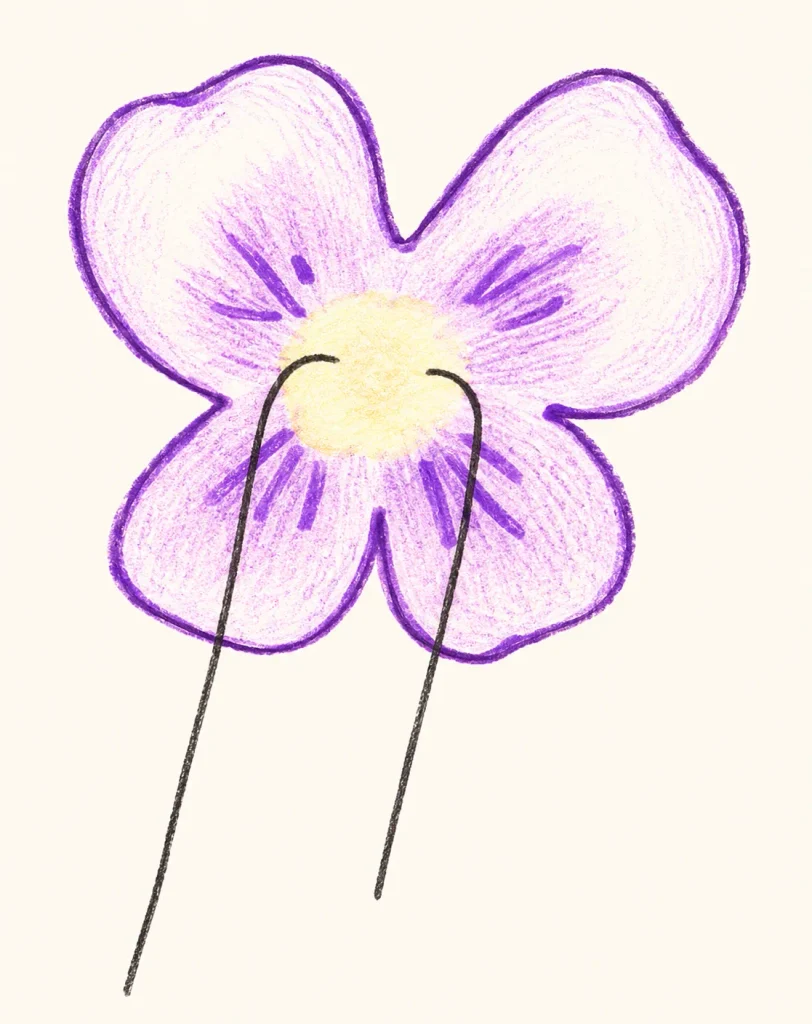
Step 4: Insert the Wire (Fig. 1 and Fig. 2)
- Insert the wire behind the flower.
- Twist the ends of the wire together to form the stem.
Tip: Gently bend the petals after the wire is in place. A slight curve gives the pansy a more natural, relaxed look.
Tips for Making Realistic Crochet Pansies
- Keep the yellow bright. The yellow center is the focal point, so choose a clear, cheerful shade.
- Choose a clear contrast. Violet and lilac should be different enough that the layers are easy to see.
- Tighten the magic ring well. A closed center makes the flower look neat from the front.
- Weave in ends carefully. Because you break off yarn after each round, you’ll have several tails. Hide them on the back so the front stays clean.
- Shape the petals gently. A slight bend at the edges looks more natural than a flat flower.
- Make a set. Pansies look best in groups. Make a few in different color variations, such as one with deeper violet and one with lighter lilac.
- Twist the wire neatly. Tight, even twists make the stem stronger.
Common Crochet Pansy Problems and How to Fix Them
The center has a gap. Pull the loose end of the magic ring more firmly before breaking off the yarn.
The petals look flat. Gently bend the outer edge after adding the wire, so the petals curve slightly.
The layers blend together. Choose colors with clearer contrast, such as a darker violet next to a light lilac.
The flower looks uneven. Count your stitches in each repeat, especially in Rnd 3, where the decreases come in groups.
The wire shows from the front. Insert it behind the flower and keep it close to the back of the stitches.
The stem wobbles. Twist the wire ends together more firmly.
Color Ideas for Crochet Pansies
This pattern uses yellow, violet, and lilac, the classic pansy mix. The same construction works with other color combinations.
| Combination | The effect |
| Yellow + violet + lilac | Classic, bright, and cheerful |
| Yellow + deep purple + white | Bold and high-contrast |
| Orange + burgundy + cream | Warm, rich, and autumn-inspired |
| Pale yellow + blue + light blue | Cool, soft, and spring-like |
| White + lilac + soft yellow | Delicate and light |
Deep violets feel dramatic, while lilac and pale yellow feel gentle and springlike.
How to Make a Crochet Pansy Bouquet
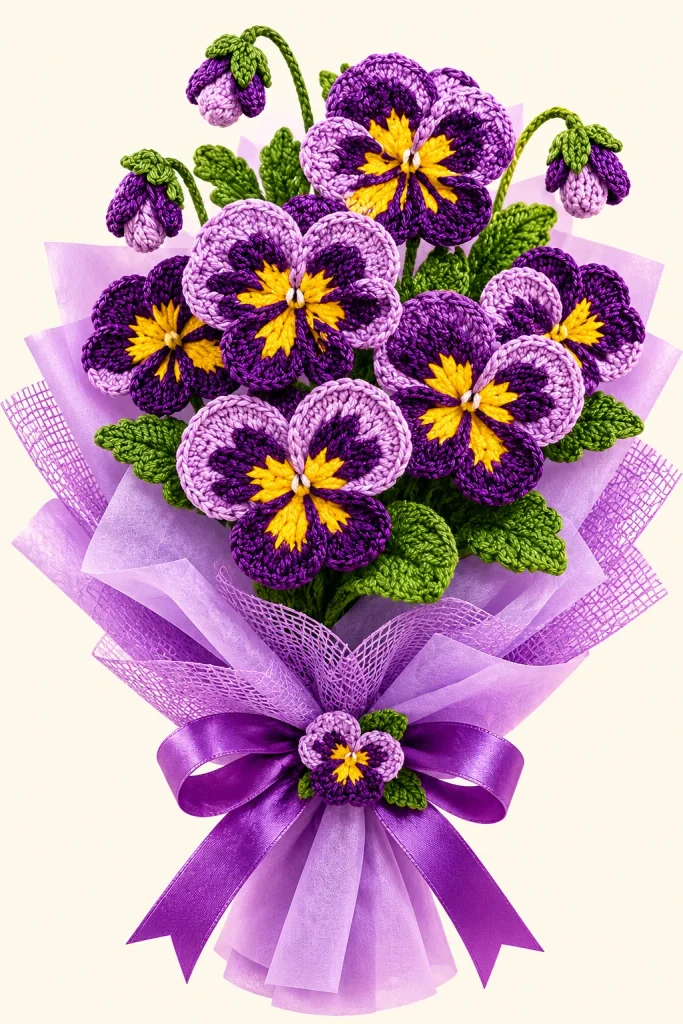
A single pansy is charming, but a small group looks even better. Because each flower has a wire stem, you can arrange them freely.
- Start with a handful. Five to seven pansies in a small jar already look full.
- Mix the colors. Make some with deeper violet and some with lighter lilac for variety.
- Vary the heights. Twist the wire stems to different lengths, so the flowers sit at different levels.
- Add contrast in shape. Pansies are small and rounded, so they pair well with taller, slimmer flowers.
Flowers that pair well with pansies:
- Crochet lavender. Its slim purple spikes add height and echo the violet tones of the pansy. See our crochet lavender tutorial for the full pattern.
- Crochet tulips. A smooth, cup-shaped flower that adds a clean shape next to the pansy’s ruffled petals. Our crochet tulip pattern is a natural companion.
- Crochet daisies. Small, flat, and cheerful, daisies add a cottage-garden feel. For other ideas, see our crochet daisy flower appliqué ideas and uses.
How to Use Crochet Pansies
- Small vase arrangements for shelves, desks, and windowsills.
- Spring bouquets mixed with lavender, tulips, and daisies.
- Handmade gifts, such as a small bouquet wrapped in kraft paper or ribbon.
- Rustic home decor, tucked into baskets, small jars, or wooden trays.
- Table decor for spring and summer gatherings.
- Gift toppers, with one pansy tied onto a wrapped present.
- Flower bed displays. Several pansies placed together in a shallow planter or tray mimic a garden pansy bed.
Caring for Your Crochet Pansies
Crochet pansies don’t wilt, so they keep their shape for as long as you want to display them.
- Keep them away from damp areas. Moisture can affect the wire.
- Avoid strong direct sun. Long exposure can fade colors over time, especially deep violet.
- Dust them gently. A soft, dry brush or a light shake keeps them clean.
- Store them carefully. Lay them flat or stand them upright in a box so the petals don’t get crushed.
Frequently Asked Questions
What yarn is used for this crochet pansy?
This pattern uses Cotton 8 in yellow, lilac, and violet. A smooth cotton keeps the petals defined.
What hook size should I use?
Use a size B (1.90 mm) hook.
How many rounds does the pansy have?
Three. Round 1 forms the four petals, Round 2 builds the middle layer, and Round 3 adds the outer edge.
What is the wire for?
The 0.6 mm wire is inserted behind the flower and twisted to form a stem, so you can pose the pansy or arrange it in a bouquet.
Do I need a magic ring?
Yes, this pattern begins with a magic ring, which you tighten by pulling the loose yarn end after Round 1.
Can I make pansies in other colors?
Yes. The same construction works in other colors, though this tutorial uses yellow, lilac, and violet.
What if I don’t understand the abbreviations?
Our guide to crochet symbols and abbreviations explains common terms in plain language.
What other flowers go well with crochet pansies?
Crochet lavender, tulips, and daisies all pair well, since they add contrasting shapes and colors.
More Crochet Ideas & Inspiration
Looking for your next crochet project? Visit our shop to explore our crochet patterns and find your next handmade project.
Follow us on Pinterest and Instagram for more crochet ideas and inspiration for your next project. We’d love to have you join our crochet community!